
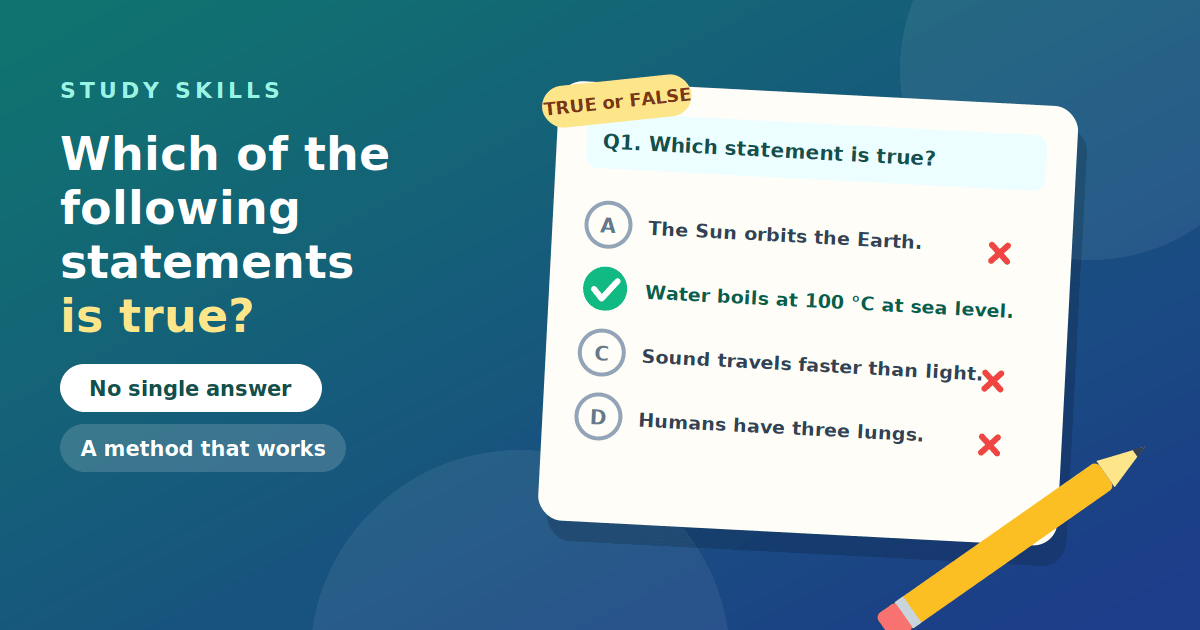
"Which of the following statements is true?" is not one question with one answer. It is the opening phrase of a multiple-choice question, and the answer depends entirely on the options that follow it. If you searched for the phrase hoping for a single answer, there isn't one. What you can do is learn how to solve this type of question, which is what this guide covers: how to read it, how to test each option, and how to avoid the common traps. The method works for school tests, driving theory tests and professional exams alike.
Why there is no single answer
The phrase is a "stem", the part of a multiple-choice question that comes before the options. Teachers and exam writers use it in every subject, so search engines see it thousands of times with different questions attached. Each question has its own correct option. A statement that is true in one question may be false in another, for example, "water boils at 100 degrees Celsius" is true at sea level and false at a high altitude.
This is why copying only the stem into a search box rarely works. To find an answer, you need the full question and all the options. We come back to that below.
What the question is really asking
The wording matters more than most students expect. The same stem can ask for different things:
- "Which of the following is true?" One option is correct and the rest contain an error.
- "Which of the following is NOT true?" One option is false and the rest are true. This reverses your usual logic.
- "Which of the following is the best…?" More than one option may be partly right, and you must pick the most complete or most relevant.
- "All of the following are true EXCEPT…" Same as NOT: you are looking for the false one.
The University of Arkansas for Medical Sciences guide warns that stems can be written as negatives and that you must read them correctly. The University of Toronto Mississauga tips suggest underlining words such as "not" and "always" because they change the meaning of the question.
A step-by-step method
- Read the stem and underline the key words. Look for NOT, EXCEPT, ALWAYS, NEVER and any numbers or names.
- Answer it in your head first. The Minot State University guide calls this the cover-up strategy: read the question and try to recall the answer before looking at the options.
- Label each option true or false. The same guide describes a true/false label strategy: treat every option as a separate statement and mark it.
- Eliminate what you know is wrong. The Montgomery College lesson on eliminating wrong answers lists reading carefully and looking for keywords as the first steps.
- Compare what is left. If two options remain, look at the exact words that differ between them.
- Check your choice against the stem. Re-read the question with your chosen answer and see whether it makes sense.
Worked examples
Example 1 (science). Which of the following statements is true?
- A. The Sun orbits the Earth.
- B. Water boils at 100 degrees Celsius at sea level.
- C. Sound travels faster than light.
- D. Humans have three lungs.
Label each one: A is false, B is true, C is false, D is false. The answer is B. Notice that the qualifier "at sea level" is what makes B correct, and this is the type of detail to watch.
Example 2 (math). Which of the following statements is true?
- A. 7 × 8 = 54
- B. 9² = 81
- C. The square root of 49 is 6
- D. 15% of 200 is 20
7 × 8 is 56, so A is false. 9 squared is 81, so B is true. The square root of 49 is 7, so C is false. 15% of 200 is 30, so D is false. The answer is B.
Example 3 (negative stem). Which of the following statements is NOT true?
- A. A triangle has three sides.
- B. A square has four equal sides.
- C. A circle has five corners.
- D. A hexagon has six sides.
Three options are true, and one is false. A, B and D are true, and C is false because a circle has no corners. The answer is C, the false statement.
Negative stems: NOT and EXCEPT
Negative stems cause more mistakes than any other type, because it is easy to read quickly and select the first true statement. A trap many exam writers rely on is the "true but irrelevant" option, a statement that is true but does not answer the question. To avoid this, circle NOT or EXCEPT as soon as you see it, and write "T" or "F" next to each option so you are not working from memory.
Common traps
- Absolute words. Options with "always", "never" or "all" are often false, because real-world rules have exceptions. The UAMS guide lists specific determiners as clues, but treat them as hints, not rules.
- Partly true options. One half of the statement is right and the other half is wrong. Read to the end.
- Look-alike pairs. The Minot State guide notes that options sometimes differ by only a word or two. Cover the others and read the stem with each option in turn.
- "All of the above" and "None of the above". If you can show that two options are true and another is false, you can usually rule out "all of the above".
- Familiar words. Do not pick an option only because it uses a term you recognize.
If you have to guess
If you do not know the answer, eliminate what you can and then guess, as long as wrong answers do not cost points. The UAMS guide says to guess when there is no penalty. It also suggests avoiding answers you have never heard of. Some guides mention patterns such as the correct answer being in the middle, but those are weak clues, so do not depend on them. A reasoned elimination beats a pattern every time.
Where to find the answer to your own question
If you have a specific homework or practice question, searching the stem alone will not work. Use these steps instead:
- Search with the full question and the key words from the options.
- Check your textbook, class notes or the course's own practice materials.
- Use the method above, because it will work even when you cannot find the answer.
- Ask your teacher or tutor to explain it if you are still stuck.
Copying answers from a website for graded work can break academic integrity rules, so use answers to learn, not to cheat. If you use study apps and websites, our guide to evaluating a software tool helps you choose well, and our time tracking guide can help you plan study sessions. If a school network blocks a study site, see why schools filter websites. For a quick brain break between sessions, our list of safe free browser games includes word puzzles.
For teachers writing these questions
If you write questions, the NC State teaching guide recommends avoiding negative stems unless necessary, since positive wording reduces confusion. It also suggests avoiding "all of the above", "none of the above" and "both A and B", which can reward test-taking tricks over understanding. Using charts, tables or figures that need interpretation tests deeper understanding than recall alone.
Frequently asked questions
What is the answer to "which of the following statements is true"? There is no single answer. It depends on the options in each question.
How do I solve a true statement question? Underline the key words, label each option true or false, eliminate the wrong ones, and check your final choice.
What does EXCEPT mean in a question? It reverses the question: three options are true, and you must choose the false one.
Should I always guess? Only if wrong answers are not penalized.
Is "all of the above" usually correct? No. Check every option before choosing it.
Can I copy the answer from the internet? For graded work, no. Use it to learn instead.
The takeaway
"Which of the following statements is true?" has no single answer, because it depends on the options. To solve it, read the stem carefully, answer in your head first, label each option true or false, eliminate wrong answers, and re-check negative wording. Guess only when there is no penalty, and use answers to learn, not to copy.