Two software products can offer the same features and still cost very differently, because of how they charge. The choice between per-seat vs usage-based pricing decides whether your bill follows your headcount or your activity. Most articles on this topic are written for vendors choosing a model. This one is written for the person paying.
The main SaaS pricing models
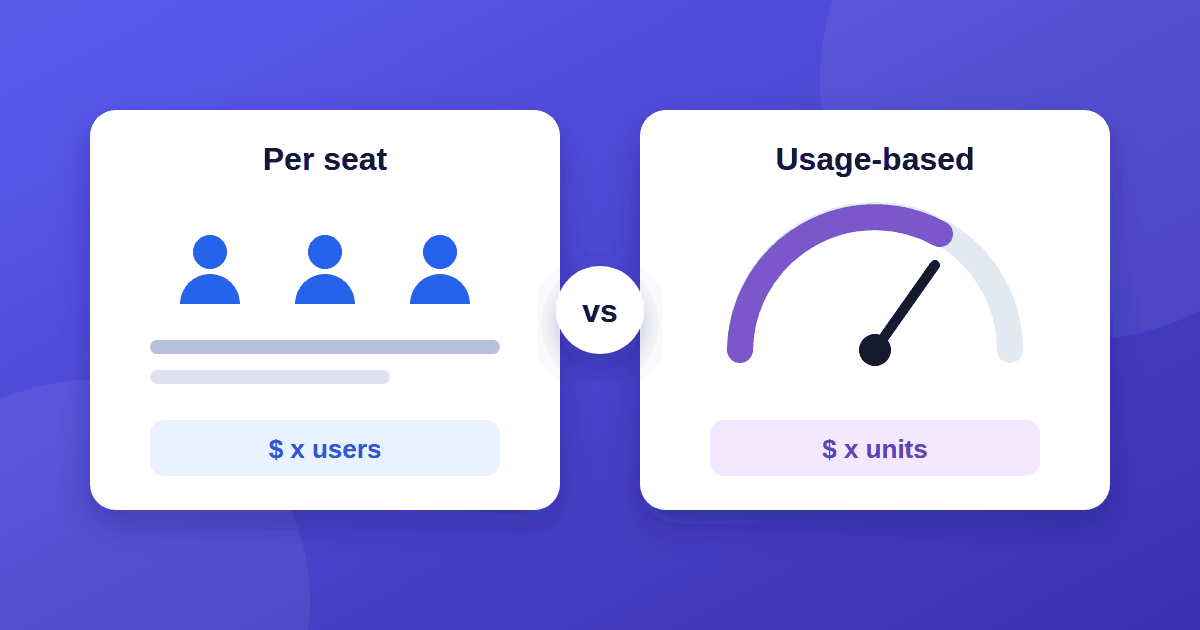
- Per-seat (per-user): you pay for each person with access, usually per month. Slack's pricing page is a familiar example of pricing based on users.
- Usage-based: you pay for what you consume, such as messages sent, contacts stored, storage, or API calls. Cloud services like AWS are pay-as-you-go examples.
- Flat-rate: one price for a defined set of features, regardless of users or usage.
- Tiered: plans with limits (users, projects, contacts) and a price step at each level.
- Hybrid: a platform fee plus usage or extra seats. Many SaaS tools now combine models.
How per-seat pricing can cost you more
Per-seat pricing is predictable, and finance teams like it. Its risk is waste:
- You pay for people who rarely log in.
- Viewers and occasional users cost the same as heavy users on some plans.
- Teams start rationing access to save money, so the tool ends up underused.
- Growing headcount raises the bill even when the work volume does not.
How usage-based pricing can cost you more
Usage-based pricing matches cost to consumption, which sounds fair. Its risk is surprise:
- Bills vary from month to month and are hard to forecast.
- A busy period, a bug, or one heavy user can spike the invoice.
- The unit being counted may not match how you think about value.
- Overage rates are often higher than the included allowance.
Which one costs less?
Neither is cheaper in the abstract. Use your own situation:
| Your situation | Usually a better fit |
|---|---|
| Small, stable team using the tool daily | Per-seat |
| Many occasional users who mostly view | Usage-based or flat-rate |
| Spiky or seasonal workload | Usage-based, with a spending cap |
| Need a fixed budget | Per-seat or flat-rate |
| Automation running in the background | Usage-based (background jobs do not occupy a seat) |
Estimate your real cost
Run this quick calculation before you sign:
- Per-seat cost = price per seat × number of people who will actually use it × months.
- Usage cost = expected units per month × price per unit, plus the platform fee.
- Add a buffer. For usage-based plans, model a busy month at 1.5 to 2 times your normal volume.
- Include growth. Redo the numbers for a team or volume 50% larger.
For example, a hypothetical tool charging a per-seat fee for 10 people costs the same whether or not all 10 use it. A usage-based tool might cost less in a quiet month and more in a busy one. Only your own numbers can tell you which wins.
Questions to ask the vendor
- What exactly is counted as a "user" or a "unit"?
- Can I set a spending cap or usage alerts?
- What happens when I go over my allowance?
- Are inactive users removed automatically, or do I keep paying?
- Is there a minimum commitment or annual contract?
- Does the price change at renewal?
How to protect yourself
- Ask for a cap or alert on usage-based plans.
- Audit seats every quarter and remove inactive users.
- Prefer monthly billing while you are still learning your real usage.
- Negotiate a fixed price for a defined volume if your usage is predictable.
- Write down your assumptions so you can check them against the first invoices.
Pricing is one part of a good purchase. For the rest, use our 10-check guide to evaluating SaaS tools, and read our guide to free backlink checkers to see what a free tier can cover before you pay.
The takeaway
Per-seat pricing fails by waste and usage-based pricing fails by surprise. Choose the model whose weakness you can live with, do the arithmetic with your own numbers, and negotiate caps and alerts before you commit.