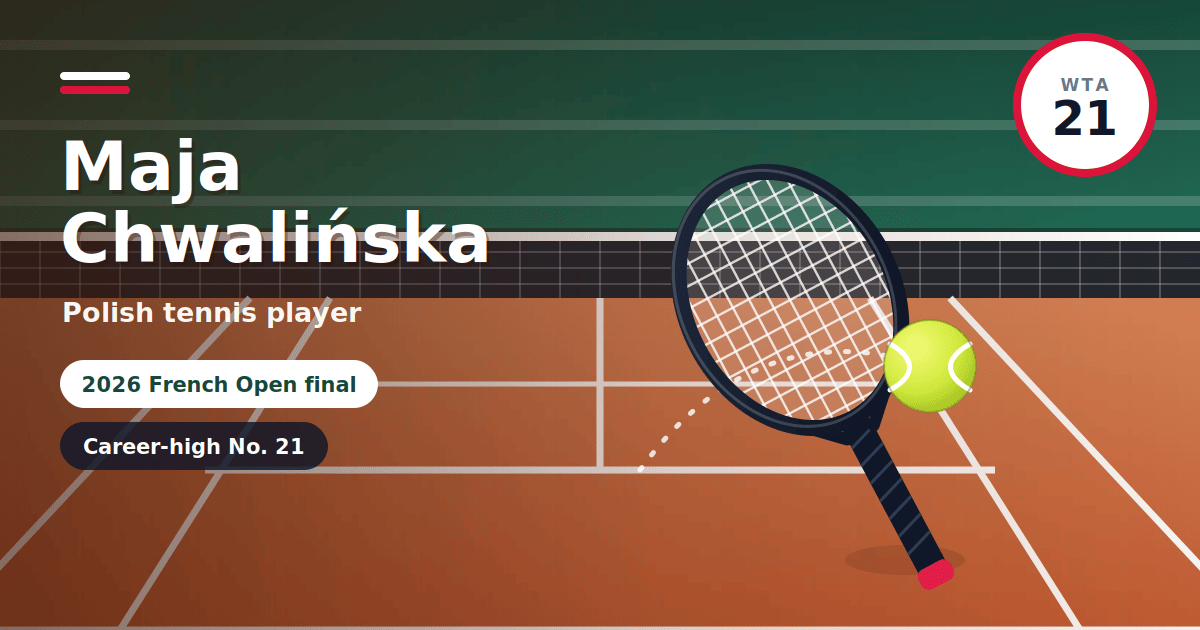
Maja Chwalińska is a Polish professional tennis player who reached the final of the 2026 French Open as a qualifier. That run lifted her from No. 114 in the WTA singles rankings to a career-high No. 21 in a single week, and it is why her name is suddenly one of the most searched in tennis. This profile covers who she is, how the run unfolded, her ranking, and her results. It sticks to public career information.
Quick facts
| Item | Detail |
|---|---|
| Full name | Maja Ewa Chwalińska |
| Born | 11 October 2001 |
| Nationality | Polish |
| Best Grand Slam result | Runner-up, 2026 French Open (as a qualifier) |
| Career-high singles ranking | No. 21 (8 June 2026) |
| Singles titles | 3 WTA 125 titles, 11 ITF titles |
Ranking and record figures here come from the WTA, Wikipedia and TVP World, and ranking numbers change every week.
Who is Maja Chwalińska?
Chwalińska is from Poland and had a notable junior career. Before the 2026 season she spent most of her time on the ITF circuit and the second-tier WTA 125 events, with occasional appearances in qualifying at bigger tournaments. TVP describes her as a childhood friend of Iga Świątek.
Her path is a good example of how tennis rankings work. Players build their ranking one tournament at a time, so a long run of solid results on lower-level tours can leave a player ranked outside the top 100 even when the quality of play is higher. A deep Grand Slam run changes that very quickly.
The 2026 French Open run
Chwalińska entered the 2026 French Open ranked No. 114 and had to win her way through qualifying to reach the main draw. She then kept winning, including a win over Anna Kalinskaya, and went all the way to the final. According to Wikipedia, she was the first qualifier to reach the women's singles final at the tournament. She lost the final 6–3, 6–2 to Mirra Andreeva on 6 June 2026, as TVP World reported. Per the tournament page, she was only the second qualifier in the Open Era to reach a Grand Slam final, after Emma Raducanu at the 2021 US Open, and her No. 114 ranking made her the lowest-ranked French Open finalist in its history. TVP World adds that she is only the fourth Polish woman to reach a Grand Slam singles final.
Some early coverage described her as a semifinalist while the run was still in progress, so older profile pages may be out of date. The final is her best result so far.
Ranking
The WTA rankings published on 8 June 2026, right after the tournament, moved her up 93 places to a career-high No. 21, as reported by TVP World and the WTA. The result also guaranteed her direct entry to the biggest tournaments after years of fighting through qualifying draws. Her ranking was No. 22 in the update published on 20 July 2026.
The ranking changes every Monday, so treat any number you see on a profile page as a snapshot. The current figure is on the WTA's player page, linked below.
Titles and results
- WTA 125 titles: three: the 2024 MundoTenis Open (her first, beating Ylena In-Albon 6–1, 6–2), the 2024 Montpellier event (beating Oksana Selekhmeteva 6–3, 6–2), and the 2026 Oeiras Ladies Open (beating Sinja Kraus 6–1, 6–3).
- ITF titles: eleven in singles, including her first, in Bytom, Poland.
- Career singles record: 277 wins and 141 losses, per Wikipedia's profile.
- Grand Slam: finalist at the 2026 French Open, with a first-round exit at the 2026 US Open.
The 2026 US Open result is a reminder that one strong tournament does not guarantee consistency. Players who rise quickly often have to defend a large number of ranking points the following year.
Doubles
Chwalińska also plays doubles. At the 2024 MundoTenis Open she won the doubles title with Laura Pigossi, and Wikipedia notes that she was the first player to win both singles and doubles at that tournament. Her doubles ranking is far lower than her singles ranking, since her focus is on singles.
How to follow her results
- WTA website: the WTA site has live rankings, match results and stats.
- Tournament draws: check the draw pages of the event she is entered in, since qualifying and main draw entries are listed there.
- Official event sites: the Roland-Garros website and each tournament's own site post draws, order of play and results.
Avoid sites that offer "live scores" behind pop-ups or ask you to download something. The official WTA and tournament pages are free. Our safety checklist for browser game sites covers the same warning signs (forced downloads, pop-ups, unclear owners), and our guide to finding reliable news sources explains how to tell an original report from a copy.
How a Grand Slam qualifier run works
To see why Chwalińska's result stands out, it helps to know how a Grand Slam draw is built. The women's singles main draw at the French Open has 128 players. Most get in directly because of their ranking. A smaller group earns the remaining spots by winning through a separate qualifying tournament played the week before, usually three rounds against other players who missed direct entry.
A qualifier therefore plays three extra matches before the tournament even starts, then has to win seven more in the main draw to reach the final. That is ten matches in roughly two weeks, often on clay, which is the slowest and most physically demanding surface in the sport. Wikipedia describes her as the first qualifier to reach the women's singles final at the event, which is why the run drew so much attention outside tennis circles.
It also explains why her ranking at the time was misleading. A player ranked No. 114 is not a beginner. She is among the best 120 or so women in the world, but just short of automatic entry to the biggest tournaments. A strong fortnight can change that overnight.
What the ranking jump means
WTA rankings are based on points earned at tournaments over a rolling 52-week period. Each round you win at an event adds points, and the points get bigger as the tournament gets bigger. Grand Slams offer the most. Under the WTA's standard scale, the runner-up at a Grand Slam earns 1,300 ranking points, which is why one tournament moved her up 93 places in a single update.
Two practical things follow from that:
- The points expire. Results older than 52 weeks drop off the ranking, so a player has to repeat strong results to stay high. The following year's French Open is when she will need to defend her points.
- Seeding changes. A top-25 ranking usually means being a seed at the next Grand Slams, which avoids facing the strongest players in the early rounds and makes deep runs easier.
This is why the ranking number moves even when a player does nothing remarkable. It reflects the last year of results, not a permanent ability level, so a rank like No. 21 or No. 22 may look different a few months later.
Frequently asked questions
How old is Maja Chwalińska? She was born on 11 October 2001, so she is 24 and turns 25 in October 2026.
Where is she from? She is Polish and represents Poland on the WTA tour.
What is her highest ranking? Her career-high singles ranking is No. 21, reached on 8 June 2026, right after the French Open.
Did she win the French Open? No. She reached the 2026 final as a qualifier and lost to Mirra Andreeva 6–3, 6–2. It is her best Grand Slam result.
How many titles has she won? Three WTA 125 singles titles and eleven ITF singles titles, according to Wikipedia's profile.
Is she related to Iga Świątek? No. TVP World describes the two as childhood friends, not relatives.
Where can I see her current ranking? The WTA player page shows the ranking week by week. Wikipedia lags by a few days, so for a live figure use the WTA.
Why do some sites spell her name differently? Chwalińska has a Polish letter (ń). Many English-language sites drop the accent and write "Chwalinska", and both spellings refer to the same player.
The takeaway
Maja Chwalińska is a 24-year-old Polish player whose run from qualifying to the 2026 French Open final took her to a career-high No. 21. She has three WTA 125 singles titles, including Oeiras in 2026. For the current ranking and schedule, use the WTA player page, since both change every week. For another widely searched profile, read our explainer on Millie Bobby Brown's husband, or browse all Guides.